

Every month a slice of your salary goes into a pension before it ever reaches your current account. Then you sit down to tot up what you’re worth, and that money is nowhere on the list.
Plenty of first attempts at a net worth sheet look like that: they record what’s visible and skip whatever is parked with a provider. Whether a pension should be included in net worth has a short answer. Yes, it counts. Working out the figure takes longer, because pensions come in several shapes and only some of them print a balance. The State Pension needs a separate conversation.
Verdly publishes for education, not financial advice. Your circumstances will differ, so speak to a regulated adviser for decisions specific to you.
Locked money is still your money
Picture a five-year fixed-term deposit. You can’t touch it until it matures, and nobody would leave it out of their savings total for that reason. A pension runs on the same logic over a much longer horizon. Net worth adds up everything you own and takes away everything you owe. When you can spend each piece is a separate matter: a credit union account is available on demand, a pension only from the ages your scheme’s rules allow.
The official statistics count it. The CSO’s Household Finance and Consumption Survey 2023 puts voluntary pensions among the financial assets in household gross wealth, and arrives at net wealth by subtracting debt. The sums involved are large. In the Central Bank of Ireland’s Household Wealth Report for the first quarter of 2026, insurance and pension entitlements came to €312.0bn, almost half of the €643.8bn Irish households held in financial assets. Insurance is folded into that category, so pensions alone are somewhat smaller, but a sheet that skips the pension is still missing one of the largest things most households have.
PRSAs and DC schemes come with a balance
If you pay into a PRSA, a personal pension or a defined contribution (DC) scheme at work, there’s a fund in your name. Money goes in, it’s invested, and its value rises and falls with markets. Your provider can tell you what it’s worth on any given day.
That’s the straightforward case. The latest statement or online portal gives a balance, and recording it with its date is all the valuation there is. Being out of reach for now doesn’t call for a discount, any more than the fixed-term deposit gets marked down for being fixed.
People who’ve moved jobs often have more than one of these: an old employer scheme here, a PRSA there. Each gets its own line, the way two current accounts would.
The balance is before tax
The balance you see is a pre-tax figure, and Revenue takes its share when the money comes out. Revenue’s rules on retirement lump sums allow €200,000 tax-free over your lifetime across all retirement lump sums, tax the portion from €200,001 to €500,000 at 20%, and tax anything over €500,000 under PAYE. A personal pension holder can take up to 25% of the fund as a lump sum, while an occupational scheme bases it on salary and service. Pension income after that is taxable as well: Citizens Information explains that occupational pensions are generally taxed through PAYE and carry USC, but not PRSI.
That leaves two defensible figures for the same fund: the balance as it stands, or an estimate of what remains after tax. The after-tax version depends on how and when the money is drawn, which can’t be known years in advance, so many people record the balance and note that it’s pre-tax. Whichever figure goes on the sheet, keeping it consistent from month to month is what makes the trend readable.
Defined benefit schemes have no fund to read
A defined benefit (DB) scheme, found across the public service and in some long-established company schemes, promises a pension based on salary and years of service. Nothing in it is ring-fenced as your fund, so there’s no balance to look up, which is the main reason DB pensions get left off.
Valuing one means estimating. The question to ask is what lump sum would buy the same income for life. Your annual benefit statement shows the pension the scheme expects to pay, and what that income would cost to buy moves with your age and with market conditions, so a multiple of the annual pension is only a rough guide. A DB line works best labelled as an estimate with a wide margin, worked out the same way each time so the trend follows the pension itself.
At retirement: ARF or annuity
Once a DC pension is drawn, whatever is left after the lump sum usually goes one of two ways. An Approved Retirement Fund (ARF) keeps the money invested in your name, with a balance that goes on counting towards net worth. An annuity swaps the fund for a guaranteed income for life, after which there’s nothing left to value, and the annuity sits on the income side alongside a DB pension.
The State Pension belongs on the income side
The State Pension (Contributory) is where the mistake runs the other way, with people tempted to add it in. The maximum personal rate is currently €299.30 a week, paid from 66 and based on your PRSI contribution record, with no means test. Over a long retirement that comes to a great deal of money.
Nothing about it can be sold or passed on, though, and no fund sits behind it in your name. It’s an entitlement earned through PRSI, and when it’s paid it’s taxable income, which Citizens Information confirms for social welfare pensions. In that sense it resembles a salary that starts at 66, and it gets weighed with the other sources of income in a retirement plan.
One sheet, two totals
Sarah is 34, rents in Galway and has a PRSA worth €38,000. She also has €12,000 in a credit union account and €15,000 in an investment fund, and owes €6,000 on a car loan. Her assets total €65,000, and after the loan her net worth is €59,000, about 64% of it in the PRSA.
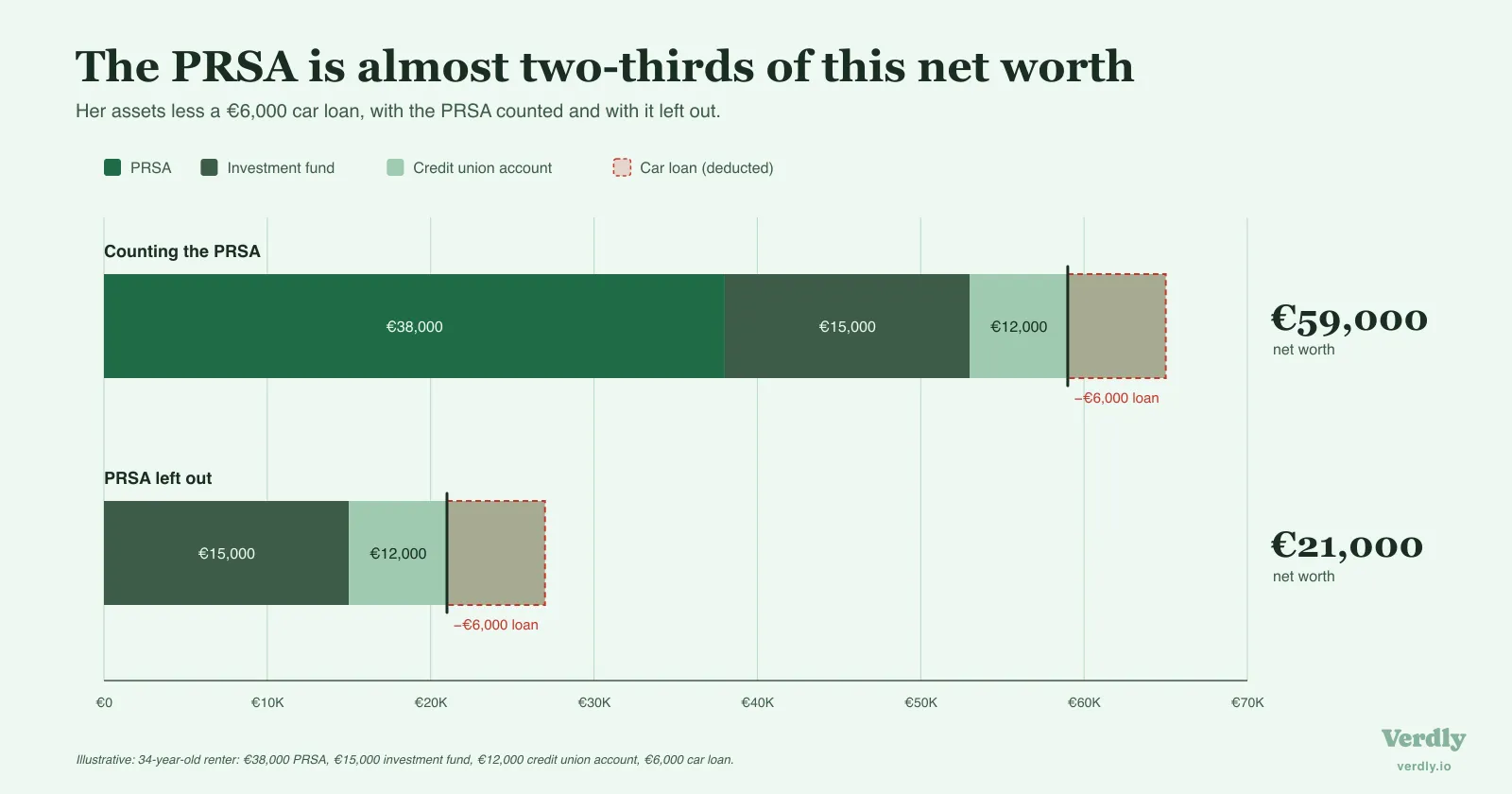
Strip the PRSA out and the sheet reads €21,000. Her accounts and her life are identical in both versions. The €59,000 describes what she owns, and the €21,000 is closer to what she could get at this month. The second number has its uses, and the pension is precisely what it leaves out.
A pension on its own line
Pensions are easy to undercount because they live outside everyday banking, in a provider’s portal opened once a year if that, and DB schemes never produce a balance at all. Counted the way this piece describes, each DC pot appears at its latest balance, any DB figure carries an estimate label, and the State Pension stays with retirement income. In Verdly, a line for each pension pot sits alongside your other assets, and the assets, milestones and import tools turn regular snapshots into a history. With its own line, the money that leaves your salary before payday gets counted like everything else you own.